
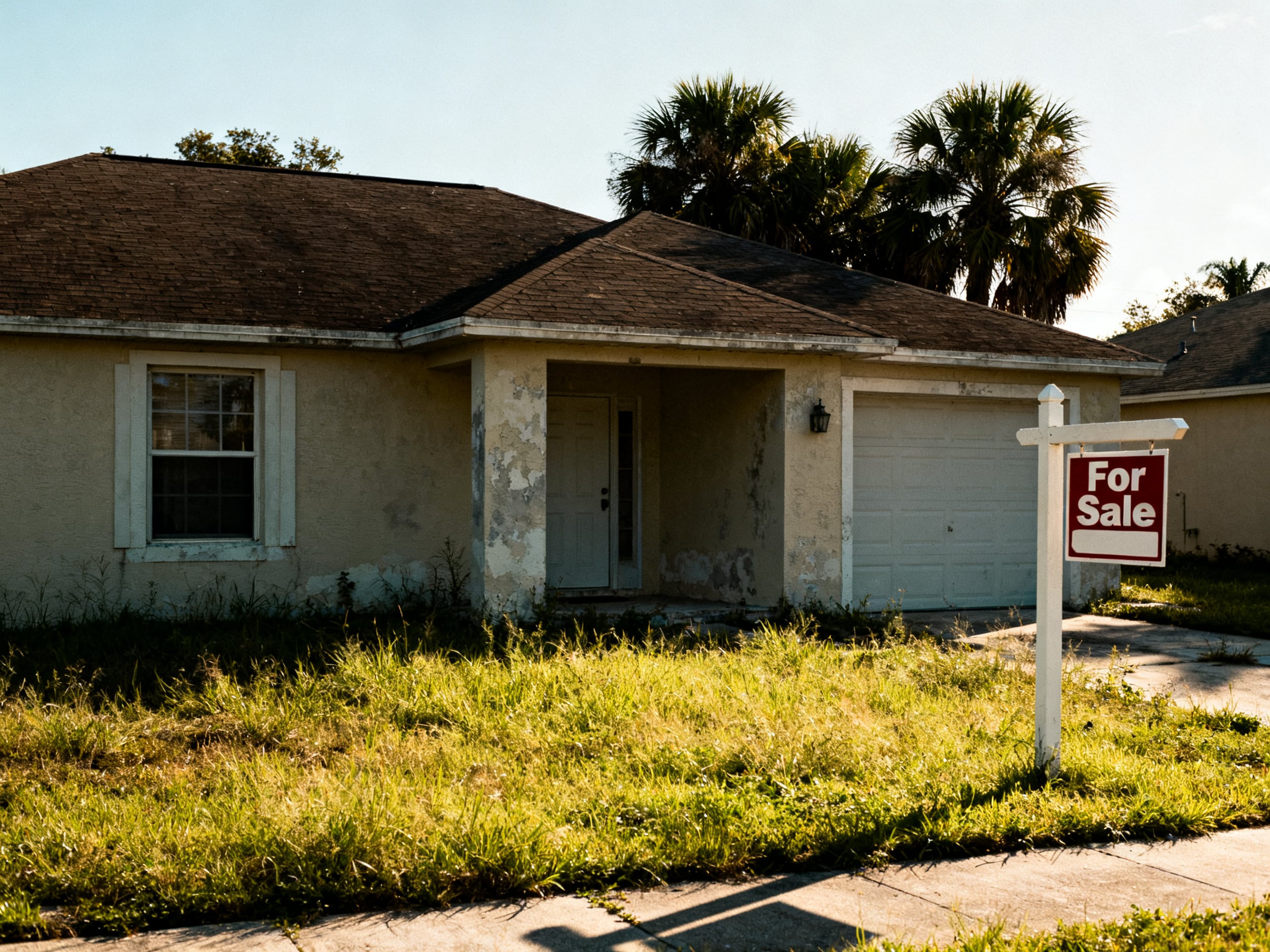
Why Is Yours Florida Home Sitting on the Market With No Offers?
Let me tell you what's really going on, because your agent probably isn't saying it out loud.
Three months. No offers. Maybe a handful of showings, a couple of low-ball walk-throughs, and a whole lot of crickets. If that's where you are right now, you're not alone. But you are stuck in a market that has completely flipped the rules on sellers, and understanding why is the first step toward actually getting your house sold.
I'm going to break this down the way I would for a friend. Florida-specific, data-grounded, no sugarcoating. Let's go.
Is the Florida Housing Market Favoring Buyers or Sellers in June 2026?
Buyers. Clearly, unambiguously, buyers.
Florida's housing market is firmly in buyer's market territory as of 2026, with the median closed price sitting just under $400,000, months of supply climbing to 7.47, and over 118,603 listings statewide. To put that supply number in context: a balanced market typically requires about five to six months of supply. Florida is running nearly two months above that threshold.
In Q1 2026, properties are sitting on the market for a median of 84 days, up from 68 days in Q1 2025 and 78 days in Q4 2025. So not only has the market gotten harder for sellers, it's gotten progressively harder throughout the past year. If your instinct was that the spring selling season would rescue you, the data says otherwise.
This is the environment your listing dropped into. And if you've been on market for ninety days, you've almost certainly become a statistic in that 84-day median, which means buyers are actively using your days-on-market number against you at the negotiation table.
How Overpriced Does a Florida Home Have to Be Before Buyers Stop Looking at It?
This one stings, but it's the most important thing I can tell you: not very overpriced at all.
If a home is even 3 to 5% overpriced, it usually sits on the market for a long time and doesn't get many showings or offers. Sellers can't expect to "leave room for negotiation" or "start high to test the market" because this strategy simply doesn't work in 2026.
That's not an opinion. That's what agents working hundreds of transactions are seeing on the ground right now. The old playbook of listing 8% over your target and letting buyers negotiate you down? It's producing ghost listings. Buyers are comparing everything online before they ever schedule a showing. If your price doesn't pass the math test instantly, they click to the next property and never come back.
Most Florida homes are selling below their original list price, with about two-thirds receiving at least one price reduction before going under contract. The statewide average closing price sits near 95 to 96% of original list.
Read that again: two-thirds of Florida homes that closed required a price cut to get there. If you haven't reduced yet, the market is waiting for you to blink.
What Does Florida's Home Insurance Crisis Have to Do With Your Listing Not Selling?
Everything. And this is the part most sellers don't connect until it's too late.
Florida homeowners insurance averages roughly $11,759 per year for $300,000 in dwelling coverage in 2026, the highest in the nation and nearly five times the national average of $2,377. When a buyer sits down to calculate their true monthly cost of ownership on your property, they're not just running mortgage math. They're factoring in an insurance bill that can add $800 to $1,000 per month on top of their payment, before property taxes, HOA, and utilities.
Buyers aren't just looking for cosmetic upgrades anymore. They're looking for insurance-friendly homes: renovated properties with newer roofs, updated systems, and documented improvements, which are increasingly viewed as lower-risk purchases. In many cases, buyers are willing to pay more upfront for homes that reduce insurance headaches later.
If your home has a roof that's fifteen years or older, an aging HVAC, or any history of water damage or claims, buyers using conventional financing are running into walls. Lenders require insurable properties, and underwriters in Florida are increasingly flagging older roofs for non-renewal or sky-high premiums. For homeowners trying to sell the traditional way, no insurance means no buyer, because no lender will fund a mortgage on a home that can't be insured.
This isn't a soft obstacle. It's a hard stop. And if your home has any of these flags, you have a structural problem that a price reduction alone won't fully solve without addressing the underlying condition.
Why Are Florida Buyers So Much More Cautious Right Now Than a Year Ago?
Because they can afford to be. Supply has given them options they simply didn't have during the pandemic frenzy, and mortgage rates have made them excruciatingly cost-conscious about every single line item.
Price reductions are visible on about 22% of active listings in markets like Orlando, compared to roughly 15% a year ago. Buyers have more time to review disclosures, schedule inspections, and negotiate terms.
When there's one home for every five buyers, people make fast, emotional decisions. When there are five homes for every buyer, they slow down, compare, negotiate, and wait. The days of expecting multiple offers above asking price automatically are largely behind us. Pricing competitively and ensuring the home is in good condition are now key.
Economic headlines, interest rate changes, and recession talk have left many households cautious about making big decisions. Market uncertainty and economic fears are combining with the affordability concerns tied to moving. The Iran conflict driving oil prices up, inflation running at 4.2%, and the Fed holding rates steady have created a buyer psychology of deep hesitation. They are not in a rush. They will not be rushed. And any sign that a seller is inflexible or overconfident will send them straight to the next listing.
Does Where You Are in Florida Make a Difference in How Long Your Home Sits?
Significantly. And if you're in the Gulf Coast or Sun Belt pockets, the situation is materially more difficult.
Price trends vary significantly across Florida submarkets. Markets like Panama City Beach are down 5.8%, Wildwood and The Villages are down 4.0%, while some Gulf Coast markets like Cape Coral and North Port are showing even larger gaps as inventory has expanded faster than demand.
Gulf Coast markets like Cape Coral and North Port are softening hardest. South Florida coastal metros lead the country in below-asking discounts, with West Palm Beach, Fort Lauderdale, and Miami showing discounts of roughly 5% off list.
Meanwhile, markets like Jacksonville have inventory back to roughly a four-month supply, with new listings spending approximately 50 days on market and some multiple-offer situations still occurring for in-demand areas and price ranges.
The point is this: there is no single Florida market. There are dozens of micro-markets moving in completely different directions right now. Your strategy has to be calibrated to your specific zip code, not a statewide headline.
What Can You Actually Do If Your Florida Listing Has Gone Stale?
Here's what I'd do, and what I'd tell anyone I know sitting in this position.
Get brutally honest about your price. Not the price you wanted. Not the price your neighbor got in 2022. The price that homes exactly like yours are actually closing at right now in your zip code. Homes that enter the market correctly priced for their condition and location are still selling in two to three weeks with solid offers. Homes that come in too high and need a reduction are sitting 45 to 60 days and attracting lower offers. A well-priced home still moves in this market. Yours just needs to be that home.
Address the insurance problem proactively. Get a wind mitigation inspection done. It typically costs $75 to $150 and can unlock substantial discounts for buyers. If your roof is aging, get a professional assessment and have that documentation ready. Proactively getting a wind mitigation report and shopping policies before listing can make your home more attractive in a more balanced market. Buyers who already know what they'll pay for insurance are buyers who can confidently make an offer.
Consider offering a seller-paid rate buydown. Seller-funded rate buydowns are one of the top incentives being offered in the current market, especially in markets where rising property prices, elevated taxes, or home insurance costs are adding to buyer hesitation. This is the single most powerful lever available to resale sellers right now. Instead of cutting your price by $15,000, spend that capital buying the buyer's rate down by a point or two. The net effect on their monthly payment is often larger, and it's far less visible publicly than a price reduction.
Consider temporarily pulling your listing. A stale listing with high days-on-market becomes a red flag to buyers. Taking it off the market resets the optics. Every day you sit accumulates negotiating ammunition for the buyer on the other side of the table. Sometimes a thirty-day strategic reset, freshen the photos, address any visible condition issues, come back with a sharper price, is more valuable than grinding through another month of silence.
The Bottom Line for Florida Sellers in June 2026
If your Florida home has been sitting for three months with no offers, the market is sending you a message. It's not subtle, and it's not going to change without action on your end.
Florida's market has not clearly chosen its 2026 path yet. Whether conditions settle into steady patterns or time on market continues to grow through the summer remains an open question. What I can tell you is that correctly priced, insurance-friendly, well-presented homes are still selling. The ones sitting on the market for ninety-plus days share a common set of problems: they're priced for the market of eighteen months ago, they've got condition flags that are killing buyer financing, or both.
The crash isn't coming. But neither is a sudden wave of desperate buyers ready to overpay for your home. The path forward is a realistic price, a proactive approach to Florida's insurance reality, and a willingness to compete in a buyer's market rather than against it.
I'll keep watching these numbers every week. Drop your market in the comments and let me know what you're seeing. The hyperlocal data always tells the most honest story.
